Break-Even: What PSA 10 Rate Does A Card Need?
How often a card has to gem to pay for itself, and why expected value beats the best case.
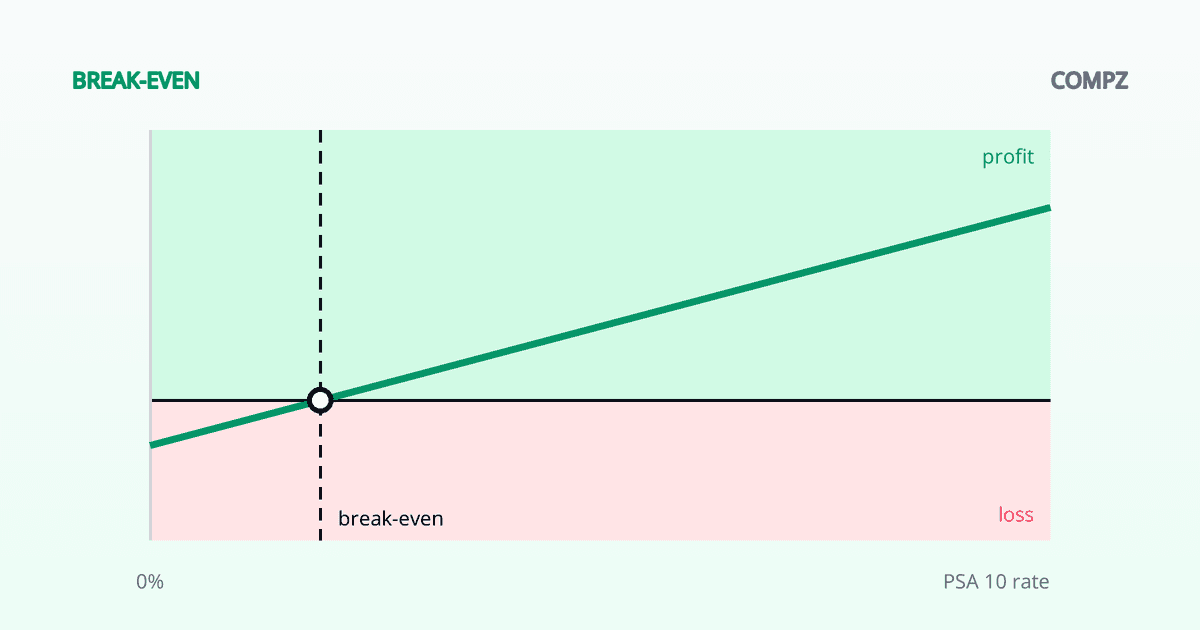
Short answer: a submission breaks even when the PSA 10s you hit pay for the ones that come back lower. The share of 10s you need is:
Here “total cost” is the raw card plus the PSA fee plus time cost, and “net” means after selling fees — the same pieces as in how to calculate grading ROI. If you think your copy's chance of a 10 is above that rate, the submission makes money on average. If it's below, it loses on average, however good the PSA 10 price looks.
Why the best case isn't the answer
The PSA 10 profit is a best case. You don't get the best case every time — you get a mix of outcomes, and the mix is what you earn over a stack of submissions. That average is the expected value:
Worked example · illustrative numbers
Same card, two different stories
Take the card from the ROI guide: $40 raw, $250 PSA 10, $90 PSA 9, Standard tier. Total cost is $102.07; a PSA 10 nets $217.62 and a PSA 9 nets $78.34. Assume a PSA 8 or lower sells for about $45, netting $39.17.
| Outcome mix (10 / 9 / 8 or lower) | Expected net | Expected profit |
|---|---|---|
| 30% / 50% / 20% | $112.29 | +$10.22 |
| 15% / 60% / 25% | $89.44 | −$12.63 |
The best case is +$115.55 either way. The average is a small win in one world and a loss in the other. The only thing that changed is how often the card actually gems — which is why the gem rate, not the PSA 10 price, decides the submission.
The PSA 9 price moves the bar the most
With only two outcomes — PSA 10 or PSA 9 — the break-even rate falls straight out of the formula. Holding everything else from the example fixed and changing only the PSA 9 price:
| PSA 9 sells for | PSA 9 net | Break-even PSA 10 rate |
|---|---|---|
| $60 | $52.23 | about 30% |
| $90 | $78.34 | about 17% |
| $120 | $104.46 | 0% — a 9 already covers the cost |
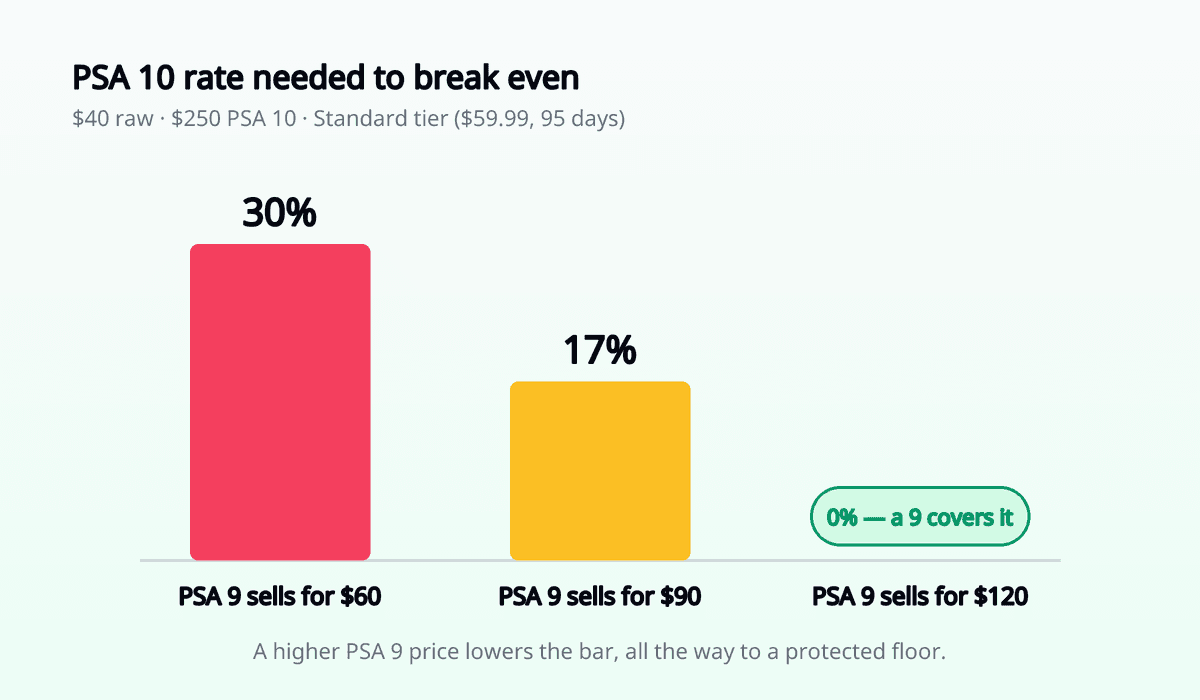
When the PSA 9 nets more than the total cost, you don't need any 10s to come out ahead. That's a protected floor. When it nets far less, you need a lot of 10s, and most raw copies of most modern cards don't gem.
Where your PSA 10 odds come from
- Your copy. The single biggest factor. A clean, well-centered copy has better odds than the card's average. See what experienced submitters look for first.
- The population report. PSA's population counts show how many copies got each grade. Treat the share of 10s as a ceiling, not a forecast: people submit their best-looking copies, so the cards in the report are already filtered.
- The set and print run. Some sets are known for centering or surface problems that make 10s scarce no matter how careful you are.
Ask “what do I need to hit?” before “what could I make?”
If the honest answer to the first question is “more 10s than this card usually gives,” the second doesn't matter.
PSA fees as of October 2026 — always confirm current tiers on psacard.com before you submit. The two-outcome table ignores grades below 9, so real break-even rates are higher when lower grades are likely.
Compz shows the PSA 9 floor and gem difficulty for each card alongside the PSA 10 upside, so you can see how high the bar is before you submit.
Check a card