How To Calculate Grading ROI
The four costs in every submission, the formula, and why the PSA 9 line matters as much as the PSA 10.
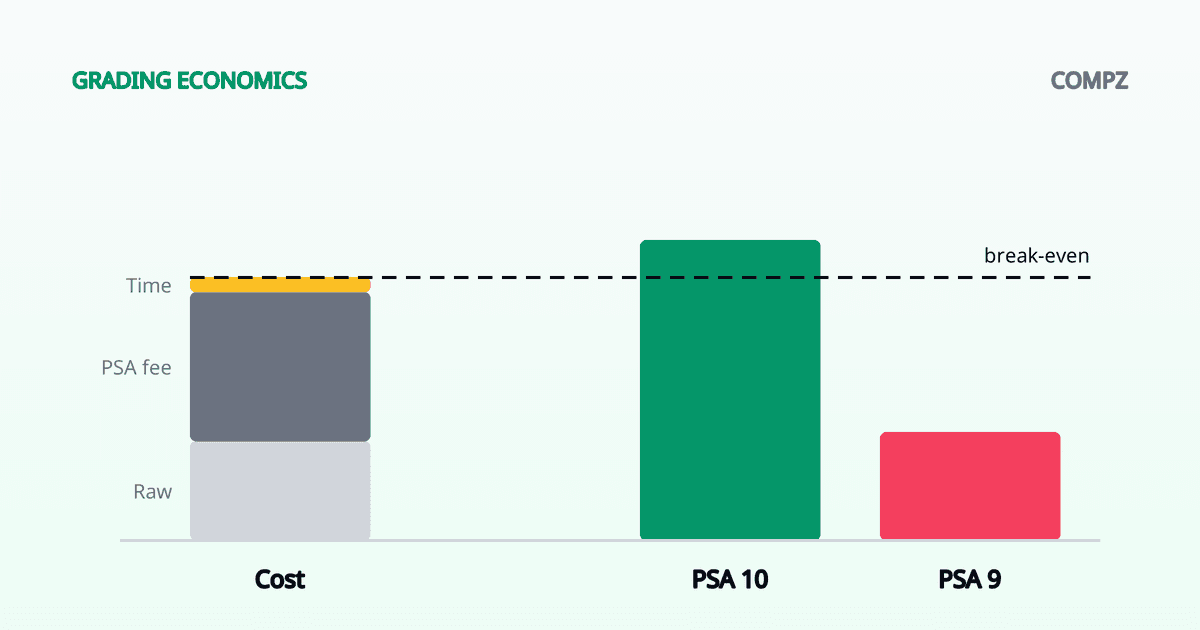
Short answer: grading profit is what you net after selling the graded card, minus everything you put in: the raw card, the PSA fee, and the cost of having that money tied up while PSA has your card. The number that matters isn't the gap between the raw price and the PSA 10 price. It's what you keep — and what you keep if the card doesn't come back a 10.
Most “is it worth grading?” math stops at the spread. A card sells for $40 raw and $250 in a PSA 10, so it looks like $210 of upside. That number leaves out three costs that every submission pays, and it assumes the one outcome you can't count on.
The four costs in every submission
- 1The raw card. What you paid, or what you could sell it for today if you already own it. Owning it doesn't make it free.
- 2The grading fee. PSA prices by tier, and the tier depends on the card's declared value — roughly what it's worth graded. As of October 2026 the cheapest open tier is Standard at $59.99 for cards declared up to $1,000, with a 90–100 business-day wait. Cards declared above $1,000 start at Regular, $79.99.
- 3The selling fee. If you sell on eBay, a slice of the sale goes to fees. Compz assumes 12.95%; your exact rate depends on the platform, category and your account, and shipping is on top.
- 4Time. Money sitting at PSA for three to four months can't be doing anything else. Compz charges 8% a year on the amount tied up for the length of the turnaround. It's small per card, but it's why a slow cheap tier isn't automatically better than a faster one.
The formula
total invested = raw price + PSA fee
time cost = total invested × 0.08 × turnaround days ÷ 365
profit = net sale − total invested − time cost
ROI = profit ÷ total invested
Run it twice: once for a PSA 10 and once for a PSA 9. The PSA 10 line tells you the upside. The PSA 9 line tells you whether you can afford to be wrong.
Worked example · illustrative numbers
A $40 raw card with a $250 PSA 10 and a $90 PSA 9
| If PSA 10 | If PSA 9 | |
|---|---|---|
| Sale price | $250.00 | $90.00 |
| Net after 12.95% selling fee | $217.62 | $78.34 |
| Raw card | −$40.00 | −$40.00 |
| PSA fee (Standard) | −$59.99 | −$59.99 |
| Time cost (8%/yr, 95 days) | −$2.08 | −$2.08 |
| Profit | +$115.55 | −$23.73 |
| ROI on $99.99 invested | +116% | −24% |
The “$210 spread” turns into $115.55 if everything goes right — and a $23.73 loss if the card comes back a 9. Neither number is the answer on its own. Whether this card is worth grading depends on how likely a 10 really is, which is what the break-even guide works out.
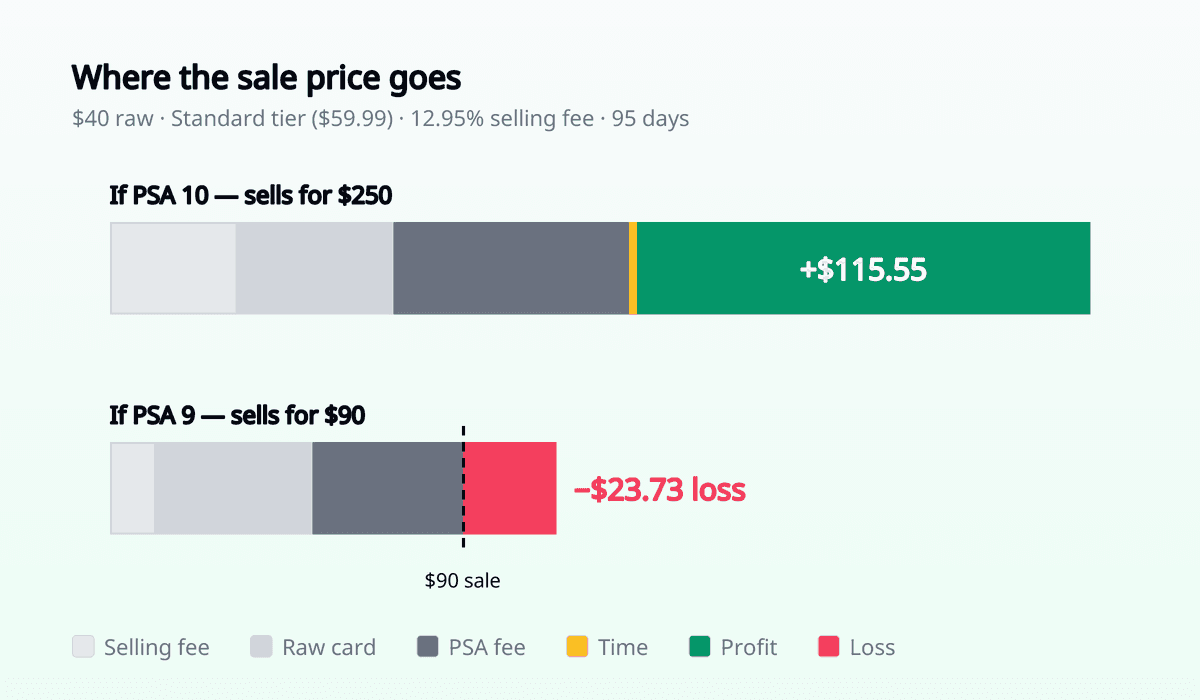
What the PSA 9 line is telling you
If a PSA 9 still makes money after every cost, the card has what Compz calls a protected floor: a missed gem is a smaller win instead of a loss. If the PSA 9 line is negative, you're betting on a 10, and the bet is only as good as your odds.
That's why two cards with the same PSA 10 upside can be completely different submissions. The biggest mistake new collectors make walks through exactly that comparison.
Common ways the math goes wrong
- Using asking prices instead of recent sold prices. Comps are what cards actually sold for.
- Forgetting the selling fee. Roughly an eighth of every sale never reaches you.
- Picking the tier by raw price. PSA tiers go by declared (graded) value, so a card worth more in a 10 can push you into a pricier tier.
- Treating a card you already own as free. Its raw value is part of the cost of grading it.
- Only running the PSA 10 line. Most submissions don't all come back 10s.
Spread is what a card could do. Profit is what it does after the costs.
The PSA 9 line is what it does when it doesn't go your way.
PSA fees as of October 2026 — always confirm current tiers on psacard.com before you submit. Examples use illustrative prices; check current sold comps for any real card.
Put in a raw price, a PSA 9 and a PSA 10 value and see both lines at today's PSA fees — or search a card on Compz to get its numbers from recent sales.
Run your own numbers