Before You Buy A Card To Grade
A pre-purchase checklist, including the most you should pay for a protected PSA 9 floor.
Short answer: before you buy a raw card to grade, know three numbers — the PSA 9 value, the PSA 10 value and your grading fee — and set a maximum price that still breaks even if the card comes back a 9. Then inspect the copy, not just the listing.
Most grading losses are locked in at purchase. If you overpay for the raw card, no grade short of a 10 gets the money back. This checklist is the order to work through before you commit.
1. Get real comps
Look up recent sold prices for the card raw, in a PSA 9 and in a PSA 10 — not asking prices. Check how often it sells. A card that trades a few times a month is harder to sell at the comp than one that trades daily.
2. Work out your fee
PSA prices by tier based on declared value, roughly what the card is worth graded. As of October 2026, cards declared up to $1,000 can go in Standard at $59.99 with a 90–100 business-day wait; up to $1,500 is Regular at $79.99; above that, the fee climbs fast.
3. Set your maximum price
The most you should pay for a protected floor — a card that still breaks even as a PSA 9 — comes from the PSA 9 net:
The 0.8705 removes a 12.95% selling fee; dividing by 1.02 covers about three months of money tied up at 8% a year, for a ~95-day wait.
Worked example · illustrative numbers
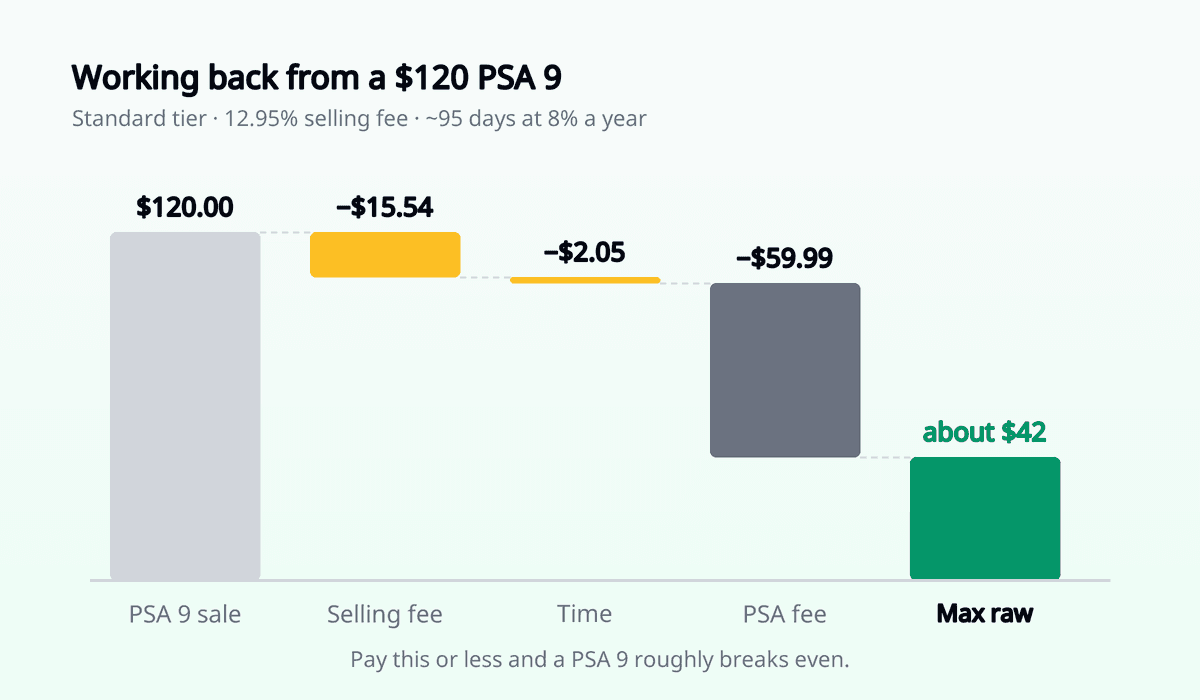
A card with a $120 PSA 9, Standard tier
$120 × 0.8705 = $104.46 net. $104.46 ÷ 1.02 ≈ $102.41. Minus the $59.99 fee leaves a maximum raw price of about $42.
Pay $42 or less and a PSA 9 roughly breaks even; anything a 10 brings is upside. Pay $60 and a PSA 9 loses about $18, so you're now betting on a 10 — see how to size that bet.
You can pay above the floor price if the card's PSA 10 odds justify it. Just know that's the bet you're making.
4. Inspect the copy
The comps describe the card. Your grade depends on the copy. Check centering, corners, edges and surface — what experienced submitters look for first covers what to look for, and how to compare multiple copies covers picking between several.
5. Check how hard the card is to gem
Look at the PSA population report. If only a small share of graded copies are 10s, assume yours probably won't be either — and remember the report already favors good copies, because people submit their best.
6. Know how you'll sell it
Decide where you'll sell, what that platform charges and roughly how long a sale takes. Selling fees and shipping come out of every number above.
The checklist in one line:
Know the PSA 9, cap your price at the floor, inspect the copy, and only pay more on purpose.
PSA fees as of October 2026 — always confirm current tiers on psacard.com before you submit. The example uses illustrative prices.
Compz shows a card's raw, PSA 9 and PSA 10 prices from recent sales, its PSA fee tier and whether the PSA 9 floor holds — the first three steps of this checklist in one search.
Search a card